
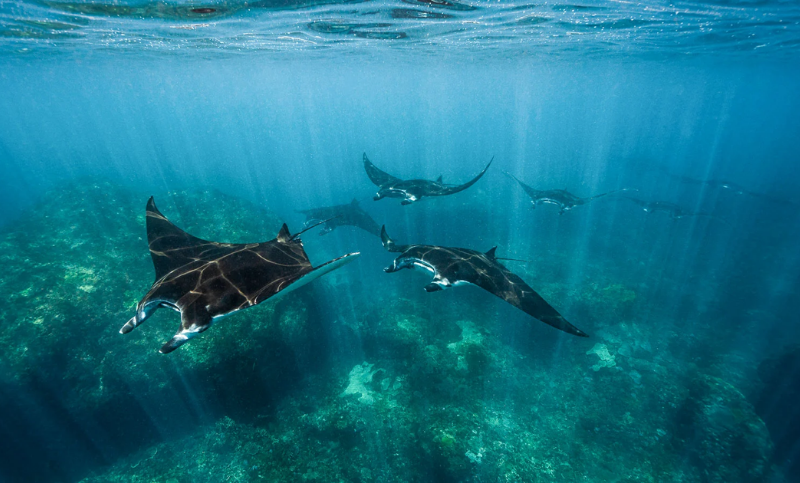
Komodo National Park has one of the most reliable reef manta populations in Indonesia, which is exactly why so many people build part of their trip around them. The good news is that mantas are seen here year-round. The more useful question is not whether they are present. It is when and where you give yourself the best shot at a genuinely memorable encounter.
Who This Is For
Divers and snorkellers planning a Komodo trip who want to see manta rays and would prefer to do that with some actual strategy rather than vague hope.
Manta Point: The Main Site
Manta Point, also known as Karang Makassar, is the best-known manta site in central Komodo. It is a long, shallow reef plateau where mantas gather around cleaning stations and feeding areas, which is why it works for both divers and snorkellers when conditions are right.
This is the place most people mean when they say they want to swim with mantas in Komodo. On a good day you may see several rays moving through the site, looping over the cleaning stations, or feeding in the current lines. It is spectacular, but it is still wildlife, not a performance on cue.
Mawan: The Other Good Bet
Mawan is another central Komodo manta site worth knowing. It is often treated as a slightly quieter alternative to Manta Point and is used by operators for both diving and snorkelling. You may still get manta action here, but the feel of the site is a bit different and, depending on conditions, can suit people who want something less hectic than the main event.
When to Visit for Mantas
Mantas are seen in Komodo throughout the year, but larger numbers in the central part of the park are often associated with roughly October to March, when plankton levels and feeding behaviour can make encounters more dramatic. That said, exact timing shifts by site and season, so it is better to think in windows than in one neat fixed “manta season”.
The practical version is this: if mantas are high on your list, you have a good chance in almost any month, but your odds of more dynamic encounters often improve in the more plankton-rich part of the year. If you care equally about visibility and photography, the trade-off matters.
What the Experience Is Actually Like
At the right manta site, you enter the water, stay calm, and let the encounter happen rather than trying to force one. The best operators position guests so the mantas can keep using the cleaning station or feeding lane naturally. The best encounters usually happen when people stop trying so hard to manufacture them.
For divers, that often means settling in low and still and letting the mantas circle overhead. For snorkellers, it means staying on the surface, keeping movement controlled, and resisting the deeply human urge to chase the thing you most want to see.
How to Not Ruin It
No touching. No chasing. No blocking their path. No flash photography. If a manta comes close, great. Let it be the one making that decision.
This is one of those wildlife encounters that gets better the less you interfere with it.
Tips for a Better Encounter
Go with an operator who understands current, tide, and manta behaviour rather than just promising the headline stop. Build in a bit of flexibility if you can. And if mantas are the main point of the trip, ask which site is producing right now rather than assuming one famous name is always the best answer on that exact day.
A rash guard or wetsuit is worth having, not because the water is especially cold, but because longer time in the water is easier when you are not getting baked by the sun from above and lightly slapped by everything else around you.